
ARTICLE
Professional Liability Insurance in the London Market

WHY THE LONDON MARKET MAY FIT YOUR FIRM’S PROFESSIONAL LIABILITY INSURANCE NEEDS
Professional liability (PL) insurance options for most U.S.-based architects and engineers primarily originate from two locations: the London insurance market and the U.S. domestic market. The two markets share certain characteristics, including common companies and people, but they also differ in several key ways.
The London and U.S. insurance markets have separate cycles. Right now, the London market is on more of an upswing than the U.S. domestic market due to the exit of several PL insurers in the U.S. over the past few years, and significant rate and appetite changes. For some firms, this may provide an opportunity to look to London for PL insurance. Assessing London market options, however, requires an understanding of the distinct characteristics of a London placement.
U.S. vs. London Market: What’s the Difference?
The fundamental differences between PL insurance from the U.S. when compared to London revolve around process and structure.
U.S. domestic underwriters work for companies based in many different cities (e.g., New York, Chicago, Hartford, Minneapolis, and Philadelphia are common headquarters for U.S. PL insurers). The underwriters themselves may work in a satellite office or remotely, which has become more typical after the pandemic. With these individuals spread throughout the county, the ability to see several underwriters to build relationships and assess options through an insurance renewal cycle can be challenging and usually involves a number of people traveling or calling into virtual meetings.
In London, there is an actual insurance market centered around the Lloyd’s of London building, with its cavernous stock exchange-like trading floor, and surrounding office buildings teeming with underwriters, brokers, regulators, and other insurance professionals. The aggregation of underwriters in the London market is partially due to the sheer volume of insurance business transacted out of London, which is where insurance first began as a business in the mid-1600s and where many global insurers remain based.
While there are also many U.S. insurance companies and offices, they interact and work together far less often than in London, where everyone is working in a tightknit market environment. In the space of a day over a series of meetings within walking distance, a firm can meet dozens of underwriters providing U.S. PL options.
London underwriters value in-person meetings to better understand the risk of a particular firm. While virtual meetings are acceptable, many firms find value in sending firm leaders to London for a few days to meet with underwriters. This process is distinct compared with what is more common in the U.S., and this relational approach fostered by geographic proximity is a key component of the London market.
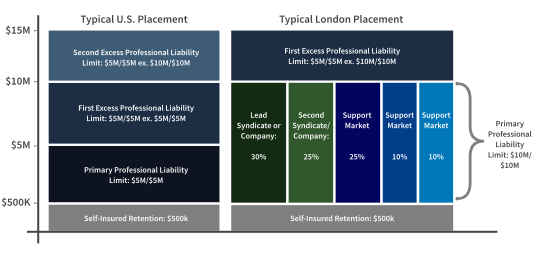
The different market conditions in the U.S. lend themselves to different insurance placement structures. In the United States, PL insurance is typically placed with a single insurance company for an individual policy. If a firm buys higher limits or needs to increase its coverage in the U.S. market, it will likely purchase more coverage in layers from another underwriter in a separate policy with a different insurer.
These layered U.S. programs often have one insurer per layer and would rarely have more than two carriers sharing coverage equally. Insurer exits from the marketplace have an uprooting impact on their clients, who then must seek out full replacement for a layer. To address this, savvy brokers try to place excess layers with underwriters who are more likely able to “drop down” to primary in the future.
In London, most individual policies have multiple insurers on one placement — a structure known as syndication (the insurers who are formally under the Lloyd’s of London corporate umbrella are called syndicates). Coverage is divided vertically among the syndicates, and every company pays a set percentage of every claim after receiving the same percentage of the premium. A single policy is typically comprised of three to five participants.
Insurers enter and exit the London marketplace similarly to those in the United States, but there is one major distinction: With the syndicated approach to PL insurance, firms are not shouldered with the burden of replacing an entire policy, of say $10 million in coverage, if a carrier exits or they have a mega claim; they may only need to replace one syndicate’s share of 10% to 25%. This enables policy language and coverage rules to stay the same, and the firm experiences little to no disruption in their coverage year-to-year.
U.S. vs. London Placement
Should My Firm’s Professional Liability Insurance Be Placed in London?
Some firms mistakenly conclude that if their firm does not have an international presence, the London market would not provide a viable option for their PL insurance. Others believe that the cost of PL insurance from U.S. insurance companies is always lower than London. These beliefs are not always true. The London market routinely offers attractive and competitive PL solutions even for firms that operate solely within the United States.
That said, firms that buy PL insurance in the London market typically have certain traits. Firms benefiting most from the London market usually have some, or all, of the following characteristics:
- Firms that want more control over PL coverage terms, claims handling decisions (including selection of outside counsel), and that desire close personal relationships with insurers
- Firms with an unfavorable claims history, either due to one substantial claim or a series of claims, resulting in fewer U.S. insurers offering competitive terms
- Firms that have had a poor claims handling experience in the U.S. and prefer the London market’s syndicated approach to underwriting and claims (including the use of U.S. monitoring counsel for claims adjustment)
- Large firms with international operations and exposures – these companies often have hefty, self-insured retentions and require higher coverage limits that are more commonly found in the London market and have international contracts with insurance coverage requirements that cannot be met with U.S. domestic insurers, particularly those constrained by filed and admitted insurance forms approved by state regulators
- Firms with high PL insurance costs driven by riskier project types, professional services disciplines, and project locations
- Cost-conscious firms whose primary concern is price or their deductible, as self-insured retention amounts are often higher in the London market on a percentage basis and premiums can be, but are not necessarily, higher in London
- Environmental firms and other certain classes of businesses that are not as attractive to London underwriters due to a history of claims disproportionately impacting the London market
- Firms that want to take a hands-off approach to managing claims. In the United States, it is common for a firm, particularly smaller ones, to have a relatively low deductible where the insurer primarily assumes responsibility for handling a claim. Because the London market has higher self-insured retention amounts, firms are far more involved in the claims process, and rely more on their coverage to backstop larger, catastrophic claims.
What Are the Benefits of London-Based Professional Liability Insurance?
In addition to the different process and structure that often comes with a London market placement, firms enjoy several more benefits:
1. Customizable Coverage
London underwriters specializing in U.S. PL focus on U.S. exposures and legal environment, so they are skilled at tailoring policy language to a firm’s individual needs. The London market offers access to surplus lines policies that are not admitted in the United States, which means that the insurers have not filed policy language with state regulators for approval.
While surplus lines placements do not benefit from state insurance schemes to protect policyholders from nonpayment of claims or insurer bankruptcy, they do allow for customized policy wording. This flexibility to meet a firm’s coverage requests usually outweighs the risk of not having a state-backed insurance fund — particularly for Lloyd’s syndicates who have significant insurer capital requirements, reserves, and a centralized emergency fund supporting insurer obligations.
For international firms or U.S.-based firms that are constrained by their domestic insurer’s filed policy form and standardized language or exclusions, a London surplus lines placement allow organizations to customize the coverage language to meet their needs. (Note: there are U.S. domestic insurers who place business on a surplus lines basis and can also offer highly customized policy language.)
2. An International Solution
The London market is a good fit for firms with international operations. Because of the different laws, customs, legal conditions, and historic insurance requirements that apply to projects outside the U.S., insurance looks and works differently in many foreign jurisdictions. London-based insurance can be particularly helpful with these international exposures and contracts.
In the United States, for example, PL policies include a per claim limit and an aggregate limit, which is the maximum allowable amount for reimbursed losses within a specified period, typically one year. In other parts of the world, such as the United Kingdom and the Middle East, there is an expectation for the limit on a PL insurance policy to apply to every claim during the policy period, without an overall policy maximum or aggregate. Contracts for projects in these locations will commonly stipulate that no PL aggregate limit is allowed, which could cost a firm the job if the applicable coverage is a U.S. based policy with a policy aggregate.
Other typical international coverage needs include coverage for civil code and strict liability, statutory inherent defects, decennial liability, indemnity to principal, and collateral warranties. London underwriters are very familiar with these requirements and can create policy language to meet them.
The right policy language can be the difference between the firm that wins or loses a project opportunity.
3. Claims Handling
With multiple insurance companies involved in a single PL policy in the London market, the claims handling process is different than a U.S. PL policy utilizing in-house claims adjustors. London markets routinely appoint a U.S.-based attorney as “monitoring counsel” on London placements, and this approach is a major differentiating factor between the markets.
With London policies, the policyholder reports the claim to the assigned monitoring attorney, who collects all relevant information, assists with strategy, monitors the claim, and provides claim status updates to the London underwriters and claims teams. These attorneys are very practical and experienced and have a wealth of knowledge and expertise to facilitate seamless claims processes. They also have flexibility to approve outside defense counsel and rates rather than having to stick to a limited list of pre-approved monitoring counsel with sometimes below market rates.
No matter how many syndicates are on a policy, no more than two lead the strategy but all pay the claim. With standard claims (under £250,000), the stipulated lead syndicate makes all the decisions, and the other participating syndicates follow suit. For complex claims (over £250,000), the lead and a second stipulated company make the decisions together, and everyone else follows behind them.
The London Market Requires an Experienced Broker
While there are many great U.S. insurance companies with experienced and stable PL underwriters, the London market cannot be disregarded as an option for many U.S. architects and engineers. Firms considering the London alternative just need to understand the differences in process and structure associated with a London placement. They also need to work with a knowledgeable and experienced specialist broker.
- There are a lot of upsides to the London market, but it is not for every firm.
- Are you interested in more creative and flexible coverage options?
- Do you have concerns about how your firm’s claims have been handled in the past?
- Are you unhappy with your current insurer?
- Do you need a new, more effective solution to manage international exposures?
- Would you like to have more stability and longevity with your insurer?
- Do you want higher limits, or a different combination of limits, self-insured retention, and premium?
- Are you curious to make sure your firm has assessed the full range of PL insurance options?
Greyling Insurance Brokerage & Risk Consulting, a division of EPIC, is a specialty insurance brokerage and risk consultant focused on design and construction professionals. Our expert professionals are here to help you navigate your insurance and risk needs by securing the most optimal solutions for your business — even if that means going across the world to find them.
AUTHOR

KENT W. COLLIER, JD
MANAGING PRINCIPAL
Kent provides day-to-day service to Greyling clients regarding insurance and risk issues in the architecture, engineering, construction, environmental, and legal service fields. He brokers practice and project specific insurance placements for A/E, construction, and law firms across the country. Drawing on years of experience as a construction attorney, Kent is heavily involved in his clients’ recognition, reporting, and resolution of insured claims.
Kent performs risk management consulting for clients including preparation and presentation of educational seminars, compilation and analysis of risk surveys, drafting and negotiating professional services contracts, and answering various client questions concerning legal, insurance, and risk issues impacting the construction and engineering industry. He has experience presenting continuing education training to staff regarding risk management, contracts, and insurance topics.