3 Common Contract Pitfalls & How to Avoid Them

Contract Pitfalls
REPORT

3 Common Contract Pitfalls & How to Avoid Them

Contract Pitfalls

In the construction industry, design services and consulting involves significant risks. Many projects are governed by lengthy and complex contracts, and legal terms often exacerbate risks.

Signing a contract without a formal, professional review exposes a design firm to inappropriate risks, making the firm vulnerable to uninsured losses. The only safeguard is a sound, rational, and business-minded professional review and negotiation of every contract. This proactively protects your firm should a claim arise, as an insurance carrier could deny a claim if a contract contains terms that jeopardize an A/E firm’s liability coverage.

A well-structured contract can serve as an essential risk management tool for the firm and provide a key foundation for a successful project. Doing your due diligence ensures fair contractual conditions that are in both parties’ best interests and further prevents an A/E firm from committing to onerous contractual terms exceeding industry standards.

3 Common Pitfalls to Avoid in Your Contracts

Contracts must be insurable to avoid claim processing delays or denials. Consider these three common contractual pitfalls:

1.   Overpromising

Architects, engineers, and consulting professionals are legally expected to follow a professional standard of care. Issues easily arise when a contract does not include the appropriate standard.

Did you know that you can contractually heighten the standard of care you agree to comply with? Seemingly harmless phrases in a contract can create a contractual obligation that design professionals would otherwise not be obligated to meet. Examples include:

  • Guaranteeing that your work will be “free from defect”
  • Warranting your services will result in a project “fit for its intended purpose”
  • Stating the services will meet a specific deadline without delays.

Elevating the standard of care could jeopardize or even negate your professional liability insurance coverage. The cost of defending a claim or lawsuit could then fall on your firm – without the benefit of insurance coverage — thereby impacting profitability or putting you and your firm at risk of a major financial loss.

Take Action: Watch out for language in a contract that is inconsistent with the common law standard of care and that demands performance beyond the baseline. Avoid phrasing such as “highest,” “world-class,” or wording that implies a design will meet every requirement or intention of the project owner. Be aware that even marketing materials may overpromise. Seek out customized contract reviews to this type of uninsurable contractual liability.

2.   Agreeing to an Immediate Duty to Defend

Another common contractual liability to avoid is the “duty to defend” in indemnification clauses. This obligates a firm to defend another party immediately upon notice or tender of a claim, regardless of who may be at fault.

The word “defend” raises significant insurability issues — regardless of the insurance company involved — because it is broader than the duty to indemnify. An A/E firm may be required to defend a claim based upon a mere allegation of negligence, whereas a duty to indemnify is triggered by a finding or agreement of actual negligence.

The high costs of defending a claim may not be insurable until a final determination of fault, leaving your firm paying out of company coffers, possibly for years. Professional liability coverage is triggered by negligence in the performance of your services, so avoid agreeing to this defense obligation in your contracts.

Take Action: Avoid agreeing to “defend” in an indemnity clause because a contractor-oriented contract is proposed or because other parties and their lawyers are focused on Commercial General Liability coverage and not Professional Liability.

3.   Proportionate Causation of Negligence

Indemnification is a contractual obligation that deals with tort liability. It is one party agreeing to be responsible for a lawsuit or damages directed against the other party.

Indemnity clauses in contracts often include many things that can “trigger” an obligation to indemnify. For an A/E firm to have an indemnity obligation that is insurable under its professional liability policy, such triggers need to be restricted or tied back to a finding of the firm’s proportionate negligence.

Including a wide range of damages and losses potentially arising from the project — such as, “any and all claims whatsoever” — under an indemnity provision might seem like covering all bases. However, the broader an indemnification agreement is, the less coverage you may have in the event of a claim.

Take Action: Include the phrase “to the extent caused by” in your indemnity clause. Avoid broader, open-ended phrases like “arising out of or related to,” which are more common in construction contracts rather than professional services agreements. If the indemnity terms go beyond this, you put yourself at risk for uncovered losses or damages as AE firms are only covered for your own specific liability to the extent damages are caused by negligence.

Being Proactive Reduces Risk

Contract review and negotiation are essential steps in managing your firm’s inherent risk. Putting in the time and effort to thoroughly review contracts and amend the language to better protect your firm can prevent costly claims and avoid uninsurable liability. Be proactive and make sure your contracts contain fair mitigation of risk, rather than waiting until a claim arises and facing potentially uninsured damages after the fact.

AUTHOR

Kelly_Jackson 2

KELLY LONG JACKSON

SENIOR CLIENT ADVISOR | CONTRACTS & CLAIMS

Kelly Jackson is Contracts & Risk Analyst with Greyling Insurance Brokerage. She supports Greyling clients through review and comment on professional services and construction contracts with respect to insurance requirements, insurability of key provisions, and other major enterprise risk issues. Kelly also assists with identification, reporting, management, and closure of claims activities on all lines of insurance coverage. She is a licensed insurance broker in Georgia.

Prior to joining Greyling, Kelly was a corporate paralegal for ten years at URS Corporation. At URS, she was responsible for a variety of corporate legal management tasks worldwide including contract review and preparation, litigation management, licensing, corporate compliance, and the Anti-Corruption and Bribery program. Between URS and Greyling, Kelly spent four years in Africa as a procurement officer in a privately held construction company.


Bridging the Cybersecurity Gap: Personal Cyber Coverage for Executives

Personal cyber protection for executives
REPORT

Bridging the Cybersecurity Gap: Personal Cyber Coverage for Executives

Personal cyber protection for executives

In today’s interconnected world, the distinction between personal and professional spheres is diminishing, particularly for executives at large firms. Historically, these individuals were leveraged as conduits for corporate fraud. For instance, in early 2024 a deceptive video call led an Arup employee in Hong Kong to transfer HK$200M (US$25.6M) to fraudulent accounts, duped by AI-generated images of company leaders.

Now, we are seeing a growing trend that those same high-profile executives are direct targets for cyberattacks.  Their visibility on corporate platforms and public records increases their susceptibility to digital threats. In a study on IT decision-makers and C-level executives, 64% of respondents believed that those in senior management positions are the most likely to be targeted by malicious cyberattacks within their organizations.

This vulnerability extends beyond corporate interests, affecting the personal lives of high-profile individuals and their families through increased incidents of credit card fraud and identity theft, often with multiple unauthorized bank accounts and credit cards opened in their names. Unfortunately, most corporate cyber insurance policies fall short in protecting the personal digital footprint of these high-profile individuals.

The Blurred Lines of Cyber Risks

Executives often find their personal information is as much a target as their professional data. Cybercriminals exploit the visibility of executives’ personal details for malicious purposes, leading to a complex interplay between personal and commercial cyber risks. The distinction between the two is becoming increasingly obscure, as attacks can originate from either sphere and impact both.

The Shortcomings of Corporate Cyber Insurance

While corporate cyber insurance is a staple in the risk management portfolio of any modern business, it typically does not extend to the personal cyber risks faced by executives and their families. These policies are designed to protect the corporate entity, its operations, and its data, leaving a significant coverage gap when executives suffer personal cyberattacks.

The Need for Personal Cyber Insurance

To address this gap, personal cyber insurance is the obvious solution. It offers personal protection against the financial repercussions of cybercrimes such as identity theft, online fraud, and cyber extortion that are not typically covered by corporate policies. Personal cyber insurance can provide coverage for expenses related to restoring one’s identity, legal fees, data recovery, and even ransom payments in the event of cyber extortion.  Additionally, some plans offer monitoring on social media, email, and the dark web as well as internet and router security across all devices to prevent exposure.

Evolving Solutions in Executive Cyber Protection

In response to this rising risk, the insurance industry is adapting with innovative solutions. A growing trend among forward-thinking companies is the adoption of personal cyber coverage as part of their executive protection strategy. These policies are standalone coverages that address the specific vulnerabilities of executives’ personal digital lives.

Insurance providers are now offering packages designed for high-profile persons with varying limits, ensuring that there is a solution suitable for every level of exposure. This proactive approach by companies underscores the recognition of the critical need to safeguard their leadership beyond the workplace. By investing in personal cyber coverage for their executives, firms are not only protecting their most valuable assets but also setting a new standard in executive risk management.

Greyling has developed partnerships with leading providers to deliver an innovative personal cyber insurance offering that provides a comprehensive suite of services designed to enhance digital security for executives and their families. With a focus on prevention, protection, and assistance, the service includes home network security, continuous monitoring, 24/7 support, comprehensive insurance with coverage up to $5M, and educational resources to empower users. 

AUTHOR

Gregg_Bundschuh (1)

GREGG BUNDSCHUH, JD

CO-FOUNDER & MANAGING PRINCIPAL

Gregg Bundschuh is a co-founder and an equity partner of Greyling Insurance Brokerage. He is nationally recognized for his active role in addressing emerging issues that affect the construction, design, and development communities. He advises clients of the firm on their insurance programs and risk management strategies. He also provides guidance to industry organizations such as the Associated General Contractors of America (AGC), the American Institute of Architects (AIA), the American Council of Engineering Companies (ACEC), and the National Council of Architectural Registration Boards (NCARB). Gregg’s unique perspective on risk and insurance issues reflects his background as a construction lawyer, a general counsel to an international design firm, and an insurance broker and risk consultant.

Gregg’s experience includes design of customized insurance policies for risks associated with building information modeling (BIM) and integrated project delivery (IPD). He has developed insurance and risk management programs for domestic and international firms in a wide range of industries. In addition, he has spoken before dozens of national and international gatherings concerned with design, construction, risk management, and insurance matters. His publications include An Owners’ Guide to Construction Risk Management & Insurance; the insurance chapter of the New York Construction Law Manual; and The Design/Build Deskbook.

9 Common Disconnects Between Private Equity’s Risk Perspective and AEC Firm Leadership

Private equity investment in the AEC industry
REPORT

9 Common Disconnects Between Private Equity’s Risk Perspective and AEC Firm Leadership

Private equity investment in the AEC industry

Receiving capital from a private equity (PE) investor or joining a PE capitalized Architecture, Engineering and Construction (AEC) firm can be a great opportunity for an AEC firm. It can transform the business, create liquidity for the owners, help you scale up fast, expand to new markets, and boost your profitability.

It also ushers in complex challenges since PE firms will often have a specific time frame earmarked for a targeted return on their investment. As a result, the AEC firm needs to learn how to anticipate and navigate the expectations of PE investors to build and maintain a strong working relationship over time.

Over the last three years, more than 400 companies have been acquired annually, a pace unprecedented and twice the rate observed a decade ago.1 While the frequency of PE mergers and acquisitions (M&A) has leveled off in the last 12 months, it’s not going away, with 2024 anticipated to be another year with over 400 acquisitions. If your firm is considering a sale to a PE- backed firm or taking on PE investors, there’s a lot to think about to ensure the path to what’s next is a smooth one.

What You Need to Know About PE Investment in AEC Firms

The number one job of the AEC firm CEO is to increase shareholder value. Most CEOs understand that explicitly and yet some may not intuitively see the connection between “risk” and “reward” and the need to quickly create shareholder value so they can achieve a successful exit and ROI. Other CEOs — by their actions or inactions — might even inadvertently diminish shareholder value.

When CEO and PE investors are not aligned around strategy, disconnects or misunderstandings happen, and the AEC firm can fail to achieve its aggressive growth objectives. Here are some of the most common disconnects between an AEC firm leadership and PE investor goals, and what you can do to bridge the two.

1.   PE firms avoid asymmetrical risk ventures.

PE investors and CEOs may not align when a firm considers taking on a project or investment that spans several years, and the upside is too limited compared to the possible downside.

For example, a PE investor might believe that at-risk contracts such as engineering, procurement and construction contracts are risky, and that the firm cannot recover from a potentially large hit to retained earnings. Because of this, CEOs need to understand the risk-reward trade-off on a five-year investment. The PE firm is trying to generate certain results within a specific time frame, and the CEO needs to understand that constraint.

2.   PE firms prefer repeatable, master service agreement-type contracts.

Large, episodic project revenue leads to risk, “lumpy” revenue projections, and discounted valuations. PE investors want their architecture and engineering firms to show smooth, steady revenue. CEOs might need to adjust the firm’s marketing and sales strategies accordingly to make sure they’re pursuing the right types of projects with recurring clients.

3.   Uninsurable risks without indemnity are outside PE appetite.

AEC CEOs need to take a big picture view of risk management and think about it from the PE investor’s perspective. Think broadly and proactively about how to account for risks, and enact a comprehensive risk management program to protect their investment. For example:

  • What are some unlikely but potentially costly risks affecting your business, industry, or geographical locations where you operate?
  • What are some unanticipated events that would be catastrophic?
  • Is your firm at risk of losing or gaining opportunities from wildfires in the Western U.S., from floods, or from other natural disasters?
  • What resources does your firm need to be competitive and innovative in your market?
  • What if you suffered a data breach or infringement of intellectual property?

4.   No leadership succession among C-suite = lower valuations.

Many AEC firms do not have a detailed leadership succession plan in writing. If a top executive leaves the firm on short notice, with no clear successor ready to step into that role, it can cause confusion within the business and hurt shareholder value. It can also cause the business to incur additional costs, such as those associated with hiring a recruitment firm for an executive search, added hiring costs, and costs of diminished productivity, lost contracts, or missed opportunities while the executive role is unfilled. 

AEC CEOs need to understand the value of succession planning — not view it as an optional/non-essential activity, or as a threat to their position. Natural attrition and proper succession planning helps reduce expenses, minimize disruptions to the business, and creates a more cohesive leadership team that can take the business to its next level of growth.

5.   Internal and external reputational risks are not tolerated.

PE investors have no tolerance for reputational risks; they are trying to help your firm grow, increase its value, and make your firm attractive to a new potential buyer or investor within the next few years. AEC CEOs need to think carefully about any possible partnerships or business relationships that could damage the reputation of the firm, including international risks and joint venture relationships. CEOs should be aware that the firm is under a higher level of scrutiny and a lower tolerance for reputational risks.

This applies to internal leadership teams as well. More than ever, firms cannot play fast and loose with ethics, misconduct, or poor professionalism among the management team.

Coddling dysfunctional leaders and turning a blind eye to bad behavior, even among “star performers,” can hurt shareholder value in the long run. When leadership teams are dysfunctional, it results in lost opportunities and operational inefficiencies, which ultimately impact the firm’s financial performance. PE investors want your company to be a tightly run ship, with a healthy culture of engaged, high-functioning people. The CEO needs to set the example, starting from the top.

Remember: Top talent doesn’t want to work for bad bosses. When your best people see bad behavior or ethical lapses get rewarded, they will either leave for another company or become disengaged.

6.   Don’t be too slow to pull the plug — or take a new risk.

Some CEOs wait too long to cut their losses on a failed strategy or a bad investment, or to engage in a potentially profitable deal.

Whether it’s a business unit in a dying market, a supposedly innovative idea from a rising leader that’s been sucking cash flow for years, or an overpriced acquisition that was an abject integration failure, CEOs need to know when to pull the plug. PE investors will want to stop the bleeding and redirect resources to new opportunities for growth instead of losing money on a bad venture.

On the other hand, for PE firms, profitable growth is the name of the game, and organic growth is only part of the formula — sometimes acquiring another firm is the best way to grow faster. Shore up your M&A pipeline and due diligence process.

7.   The two parties may not agree to appropriate levels of insurance.

Architecture, engineering and construction firms have complex, industry-specific needs for insurance, and often purchase coverages that may not adequately protect their interests. The key mantra is to “protect the house,” and insurance risk transfer across all coverage lines is a cost-effective way to accomplish that. Almost always, a PE firm will procure higher limits of insurance to do so. 

PE investors need to understand the risk factors and insurance-related aspects of running the business, along with the other strategic decisions. Similarly, CEOs need to ensure their PE investors are aligned around expectations for insurance and risk management.

CASE STUDY: Pinpointing the Right Coverage Reduces Budget

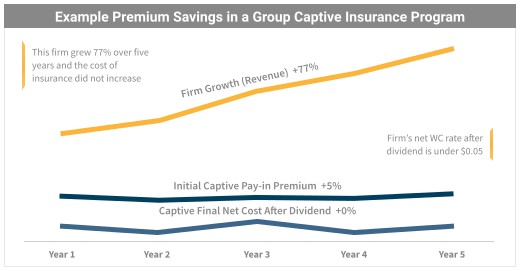
After evaluating one engineering firm’s insurance program, it was discovered the firm had insufficient cyber, professional liability and umbrella/excess coverage. To cover these deficits, Greyling recommended group captive insurance to help save on insurance costs and increase dividends, establishing a five-year timeline to achieve these goals.

In the first year, the group captive for workers compensation, auto, and general liability was implemented, which helped the organization save on insurance costs from the onset. It also created incentives through Insurance Premium Allocation, helped integrate acquisitions, and implemented better loss control measures for the firm’s fleet and workers compensation policies. The savings generated in through this alternative approach created the opportunity to increase limits for other policies without increasing the total cost of risk.

By year five, the firm’s shareholders started receiving dividends from the distribution of captive profits.

8.   The leadership thinks risk management is a “cost center.”

Some AEC CEOs still view insurance premiums and risk management training as expenses rather than investments. But risk management is not an area where organizations should curtail costs or relegate to an HR and finance function. Instead, risk management should be viewed as an investment that is central to the power of the firm’s brand.

Effective risk management helps demonstrate your firm’s commitment to quality, contingency planning, and industry expertise. A total cost of risk approach provides a metric for measuring risk and reward and the effect of investments in training on that equation. PE investors are often focused on the risks facing the business. CEOs need to be ready to discuss risk management as a central strategic factor that can help support the business’s growth and success.

AEC CEOs should consult experts in a particular area when necessary to make the correct risk management action. For example, when reviewing high value or “non-traditional” services contracts for risk exposure during due diligence, including complex structures with a higher risk profile, consider bringing in a risk management consultant or lawyer with the expertise necessary to untangle these contracts to appropriately evaluate the risk exposure.

For higher level execution of risk management, firms should consider an Enterprise Risk Management (ERM) study or the implementation of the role of Chief Risk Officer.

CASE STUDY: Due Diligence Helps Engineering Firm Grow

In 2006, one global consulting, engineering and construction management firm was valued at $265 million, but wanted help increasing revenues and reducing their insurance costs and risk.
After an initial assessment of the firm’s policies, Greyling was able to fix coverage gaps and consolidate the program before it came time to renew policies. This first step saved the company $1 million in that first year.

Another early initiative rolled out was a company-wide risk survey. The results were used to pinpoint areas for improvement and training, which the firm started implementing in that same year. The firm also established a chief risk officer position, helping to define the role and approach to enterprise risk management, and established a total cost of risk methodology for board level reporting.

Greyling also supported general counsel efforts to settle civil and infrastructure legacy claims, which helped keep renewal costs down as the claim issues faded. In addition, Greyling educated the organization’s board on its general liability, auto and workers’ compensation claim problems, which helped motivate the firm to develop safety and strategy goals and earmark staff to execute objectives, and recommended the use of specific policies to reduce cost, including the use of a group captive.

As the firm expanded, Greyling assisted with the organization’s M&A activities and started providing risk advice to manage construction exposure.

Ultimately, the engineering firm achieved a loss ratio of less than 30% by 2021 — a significant reduction from its start with the organization when it was over 100% — and increased revenues to $1.4 billion.

9.   CEOs should identify their organization’s “special sauce.”

Consider the following when identifying your organization’s niche:

  • What’s your firm’s special competitive advantage in the market that can command a premium valuation to future buyers?
  • Does your firm offer expertise in infrastructure; energy; renewables; environmental, social and governance issues; or sustainability?
  • Are you active in fast-growing markets or locations?
  • Do you have hard to replicate experience or expertise, or a great reputation among a niche client base?

Conclusion

Think strategically about what makes your firm a premium brand and how you can position the business to emphasize these unique strengths.

Working with PE investors can help take a firm to the next level of growth, but the CEO and leadership team need to be aligned with the unique expectations and perspectives that PE investors bring to the table. Stay focused on creating shareholder value, understand the risks confronting your business, and be agile and eager to capitalize on new opportunities. This way, your firm can boost your valuation, achieve big ROI, and put the company on a stronger trajectory for years to come.

AUTHOR

Gregg Bundschuh

GREGG BUNDSCHUH, JD

CO-FOUNDER & MANAGING PRINCIPAL

Gregg Bundschuh is a co-founder and an equity partner of Greyling Insurance Brokerage. He is nationally recognized for his active role in addressing emerging issues that affect the construction, design, and development communities. He advises clients of the firm on their insurance programs and risk management strategies. He also provides guidance to industry organizations such as the Associated General Contractors of America (AGC), the American Institute of Architects (AIA), the American Council of Engineering Companies (ACEC), and the National Council of Architectural Registration Boards (NCARB). Gregg’s unique perspective on risk and insurance issues reflects his background as a construction lawyer, a general counsel to an international design firm, and an insurance broker and risk consultant.

Gregg’s experience includes design of customized insurance policies for risks associated with building information modeling (BIM) and integrated project delivery (IPD). He has developed insurance and risk management programs for domestic and international firms in a wide range of industries. In addition, he has spoken before dozens of national and international gatherings concerned with design, construction, risk management, and insurance matters. His publications include An Owners’ Guide to Construction Risk Management & Insurance; the insurance chapter of the New York Construction Law Manual; and The Design/Build Deskbook.

PFAS Update

REPORT

PFAS Update

Survey of Environmental Engineering and Consulting Experts: Results & Analysis

In our first Greyling Brief on PFAS in the summer of 2019, we focused on the developing state and federal regulatory environment, the emerging market opportunities for environmental engineers and consultants, and some of the likely challenges faced by these professionals in terms of managing risks.

In the time since, we were curious to see how the environmental consulting and engineering industry is addressing some of the challenges we identified, and others that have subsequently arisen. So, we surveyed experienced environmental consulting and engineering experts focused in this area on a variety of topics dealing with PFAS. We were interested to find out:

  • Where they see the federal regulatory regime headed
  • Where they see immediate market opportunities and future growth opportunities
  • How they are managing risks through contract provisions
  • What best practices they have learned in terms of sampling and investigation
  • What applied knowledge has evolved in the field
  • What new and emerging remedial technologies are showing promise
  • How they are dealing with PFAS in terms of ASTM E1527 compliant Phase I ESAs
  • What they have learned over the last two years that has surprised them the most

We were particularly interested to learn how environmental firms are using non-insurance strategies (e.g., project selection, contract terms, best practices) to manage risk in the PFAS space.

Our survey results indicate that in emerging risk areas like PFAS, environmental engineers/consultants need expert assistance that may be beyond the understanding and abilities of most insurance brokers. Project selection and risk profiling, contract risk management, and conflicting standards are just a few examples of these important non-insurance risk management considerations.

Introduction

In virtually every area of the environmental consulting/engineering services profession, non-insurance risk management is absolutely critical in the context of strategic, financial and operational success. Adverse contract terms, ambiguous scopes of work, limitations of liability (LoL), standards of care, indemnity terms, selection of projects and clients, quality control, and many other factors are all keys to reducing exposure to litigation, professional liability claims, and draining profits.

In the emerging PFAS space, all of these become even more important. There are additional challenges and uncertainty in all of these areas. Space does not permit a detailed examination of all these challenges, but a single example should suffice.

PFAS remains outside the scope of the updated Phase I Environmental Site Assessment (ESA) standard, ASTM E1527 (updated in November 2021), as the US EPA has not yet designated any of the PFAS compounds as hazardous substances under CERCLA. ASTM’s guidance on the question of whether environmental consultants should include emerging contaminants such as PFAS in their scope of work when conducting Phase I ESAs until such emerging contaminants are regulated as CERCLA hazardous substances is essentially unchanged in the update. ASTM E1527-21 guidance indicates that emerging contaminants can continue to be included as “Non-Scope Considerations.”

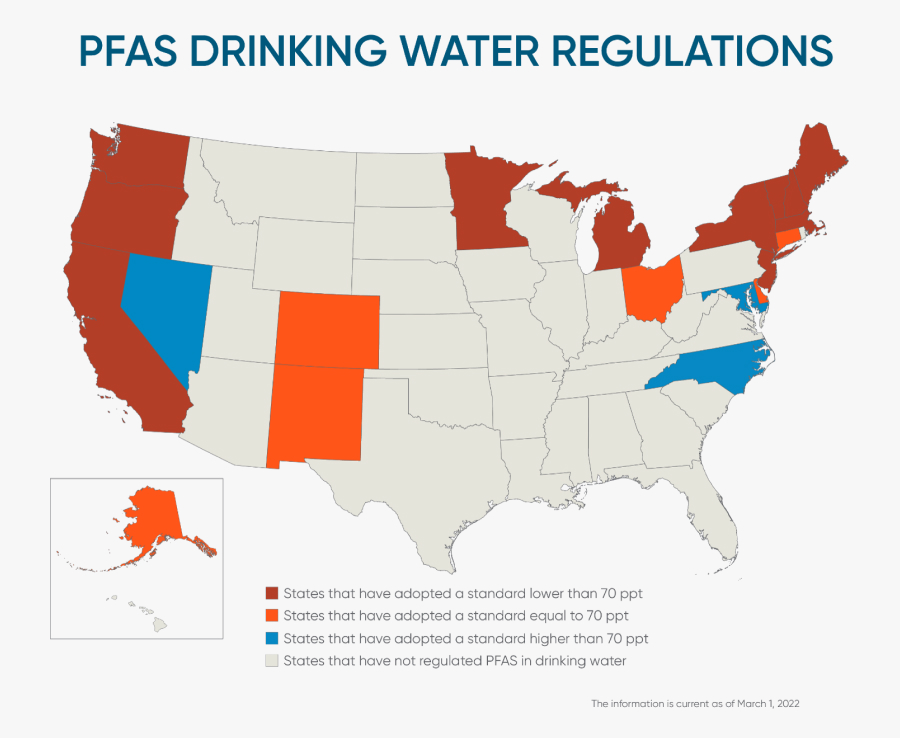
But as our sidebar notes, an increasing number of states have implemented a cleanup standard for at least two PFAS compounds since our summer 2019 Greyling Brief, and an increasing number of states have legislation pending. This also continues to create a variety of risk conundrums for environmental engineers/consultants.

How the industry deals with this uncertainty in their Phase I ESA reports for clients (using only one example: limitation of liability in contracts), how it relates to the standard of care, how to deal with the conflict between AAI under CERCLA and state analogues where non-concurrency on cleanup standards exists, and client/project selection are all critical examples of non-insurance risk management associated with PFAS-related work – and that’s only in a single, specific context!

PFAS Drinking Water Regulations by State

Survey Summary & Findings

We begin by summarizing the results of certain questions that did not directly bear on issues of risk management per se, or where the survey answers clustered around a common theme.

For example, we asked if respondents think PFAS will be listed as a CERCLA hazardous substance, and if so, why, and when. Nearly all survey respondents answered “yes”, although most do not believe the entire class of PFA compounds will be classified as CERCLA hazardous substances. One presciently suggested a scenario in summer 2021 in which EPA moves to classify at least PFOS and PFOA as U-list RCRA hazardous wastes. (In October 2021, EPA announced it was initiating rulemaking process “for two additional actions to address PFAS under RCRA”).

60% of respondents who believe CERCLA hazardous substance listing is imminent believe it will be on purely scientific grounds. But 40% of the respondents believe hazardous substance listing under CERCLA will occur for qualitative reasons, such as:

  • Public awareness
  • Sociopolitical momentum and concerns
  • Assignment of responsibility for the large number of AFFF-impacted sites
  • Removing cost responsibility from municipalities and taxpayers
  • Inability to conclude that any levels are safe

We asked whether public or private sector clients are more willing to accept Limitations of Liability (LoL) in contracts for professional services involving PFAS? With one exception, all respondents reported that the private sector is more willing to accept an LoL. We were more interested to learn how that varies by amount of the LoL, and our survey shed some light on that question.

We asked environmental professionals which remediation technologies they have actually specified in PFAS remedial design over the last two years. Granular activated carbon (GAC) and ionic exchange resins were the only technologies reported by respondents.

We asked what promising new remedial technologies they see emerging that will change the time/cost equation vs. GAC for PFAS remediation in groundwater? The most common responses included:

  • Ionic exchange resins
  • Electro Chemical Oxidation (ECO)
  • Phytoremediation
  • Gas sparging
  • Membrane technologies, specialized coagulants, foam fractionation (for wastewater)
  • Encapsulation
  • Pyrolysis
  • Supercritical waste oxidation

The survey’s key risk management findings, as well as some insights we draw from it, are found in the balance of this Greyling Report.

Where are you seeing market opportunities and where are you engaging (e.g., public vs. private, production vs. downstream, soil vs. groundwater, etc.)?

The majority of survey respondents (approx. 70%) are engaging in private sector work vs. ~30% in public sector work. Most of the public sector work is in DoD facilities related to AFFF’s and at municipal landfills, wastewater treatment facilities, and airports.

Few respondents reported working for clients engaged in production of PFAS compounds (or precursor chemicals). Common private sector industries referenced included pulp/paper, ag/dairy farming, metal plating, electronics manufacturing, law firms (for risk management and litigation), and insurance. (Regarding the last, if your Professional Liability/Contractors Pollution Liability is written by an insurer who also writes site-specific pollution liability, and you have a high level of PFAS expertise, your broker should be making sure to connect those experts with the insurers underwriting and claims staff).

Groundwater was the most commonly reported media in relation to current project focus (>70%). But a plurality of firms referenced increasing work in soil and surface water in relation to increasing concern of environmental regulators. One respondent mentioned that with Toxics Release Inventory (TRI) reporting for almost 200 PFAS compounds for the 2020 reporting year, they expect more opportunities in the private sector, as the public will have increased data on specific industries’ use and volumes of PFAS compounds.

In what % of contracts for services (involving PFAS-related work) are you able to get a limitation of liability (LoL):

a) Equal to the cost of services?
b) Of a fixed amount of $100,000 or less?
c) Of $1,000,000 or less?
d) Up to the limits of your professional liability insurance?
e) In what % are you unable to get ANY LoL and you accept it?

Interestingly, virtually all respondents reported being able to get an LoL equal to the cost of the (PFAS-related) services in ~50% of contracts, and every respondent reported being able to get an LoL equal to the cost of the services in at least 40% of contracts. At the other end of the spectrum, only one respondent reported accepting a contract without any LoL for PFAS-related services but only in ~10% of contracts. Approximately 40% of respondents reported that they would not accept a contract for PFAS-related services with no LoL. Approximately 60% of respondents reported they will accept no LoL, but only in <2% of contracts.

More than 75% of respondents reported keeping LoLs for PFAS-related services below $1 million. The overwhelming majority of firms reported they only provide an LoL up to the firm’s professional liability limits in 10% of contracts, or less.

What best practices have you learned to implement on PFAS site investigation projects?

Respondents reported a wide range of answers. Categorically, the responses centered on the following specific areas:

  • Sampling equipment matters (e.g., container/lid types)
  • Personal items (food, clothing, cosmetics, etc.) can impact sample results
  • Personal Protective Equipment matters
  • Rigorous field QC samples (incl. field blanks, source water blanks, equipment rinse blanks, etc.) are critical
  • Develop project-specific protocols but with reference to state and ITRC guidelines
  • Unique practices for sampling surface water (whether stagnant or flowing)
  • Unique practices for dealing with surface soil during boring or well installation
  • Unique practices for dealing with surface water, groundwater, wastewater with elevated suspended solids

What unique applied knowledge has evolved in the field over the last two years in this regard ?

Approximately 25% of respondents reported that early concerns about sample contamination issues have proven not to be as serious a concern as initially anticipated.

There were a number of other interesting examples provided, including:

“There are still knowledge and data gaps around the extent to-which typical sampling methods should be modified to account for unusual PFAS chemical properties. For instance, some PFAS accumulate at the air-water interface. So, concentrations may vary depending on if a sampling method collects water from the air-water interface or not.”
“The fact that our labs are not dealing with aqueous samples with suspended solids in a consistent manner means we need to be careful when utilizing data due to potential comparability issues as well as accuracy issues. Papers have come out on PFAS levels in common sampling materials and we have seen many of these materials are likely not an issue during sampling.”
“(Our firm) has established protocols for sampling and onsite work for PFAS-related remediation/investigation projects - all appear to have been developed over the last 2 years.”
“Since PFAS may be present in so many products (at levels high enough to create issues), trying to avoid all such products may not be feasible and it should not be needed, as long as best QC practices are applied avoiding direct contact of any personal products with the samples, adequate decontamination of sampling devices is performed, and any potential cross-contamination is captured by a strict field QC program with adequate field blank samples”

Given that PFAS are not listed as hazardous substances in CERCLA and all state analogues yet (out of scope for ASTM 1527-13/21), how have you been treating them in Phase I ESAs?

Virtually all respondents report addressing PFAS as an out-of-scope item in Phase I ESAs on a client and site-specific basis. The most commonly listed situations were:

  • Where site history or activities suggest likelihood of presence
  • If requested by the client
  • Considering exposure pathways, in particular drinking water sources
  • As a “business risk”

Does the above answer change/depend on whether you are advising an owner/PRP vs. a prospective purchaser?

100% of survey respondents answered “no”.

How do you treat the situation if the site is in a state that has implemented an mcl while the federal standard remains a health advisory?

The most common responses were:

  • Communication with client early in assessment to establish a general decision framework
  • States with regulations in place are the driver of regulatory action over the federal Health Advisory

One respondent replied that their firm treats these situations the same way as in states with no standards – as a business risk.

How have you seen lenders address PFAS in commercial real estate lending due diligence, or are they doing so at all?

Only one respondent reported seeing lenders address PFAS in Phase I ESAs. (No information was provided whether this was a large national bank or a local/regional bank).

Have you seen known or suspected PFAS stop a commercial real estate transaction or commercial lending in support of it?

~40% of respondents report seeing known or suspected PFAS stop a commercial real estate transaction. ~60% do not report seeing a transaction stopped by PFAS.
Is PFAS Safe to Drink?

Given the risks involved, do your projects involving PFAS undergo a separate go/no-go process for contract risk management vs. other types of environmental consulting/engineering work?

Only 20% of respondents report PFAS-related projects are required to undergo a separate go/no-go process for contract risk management vs. other types of projects. One respondent noted that the firm’s conflict of interest process has become much more sensitive and time consuming in relation to PFAS engagements.

What have you learned over the last two years about PFAS in terms of due diligence, site investigation, remedial design, contract risk management, client expectations, market evolution, emerging remedial technologies, or any other facet that has surprised you the most?

The most common responses included:

  • How widespread PFAS impacts are across a variety of industries and environmental media
  • That states having lower mcl’s than the EPA Health Advisory are not likely to consider site-specific science that the value should be higher
  • The lack of significant increase in client work to address PFAS (notes confusion between state and federal agencies)
  • How rapidly science is evolving
  • How few PFAS compounds characterized in terms of toxicology, fate/transport, distribution and transformation
  • Differences in lab analytical procedures (e.g., sample prep, equipment calibration, etc.)

Aside from the chemical manufacturers and airports, where do you see the biggest growth opportunity for your PFAS-related consulting/engineering services (e.g., landfills, municipal water/wastewater systems)?

The most common responses were (without regard to order/frequency):

  • Department of Defense sites
  • Municipal solid-waste landfills
  • Municipal wastewater systems
  • Bulk fuel terminals
  • Refineries
  • Chemical-using industries
  • Oil/gas
  • Chrome plating
  • Pulp/paper
  • Litigation/law firms
  • Risk management planning (many industries)
  • Major industrial fires/explosions

If you have any other (non-insurance) risk management advice for environmental professionals operating in the PFAS space that you are willing to share which we have not touched on, please feel free to provide it here.

Respondents strongly recommended keeping up to date with evolving science and with state and federal regulations. Two other answers we noted below (emphasis ours):
“The sheer number of individual PFAS, their extremely diverse uses, along with the very low regulatory limits may not preclude some degree of risk for any site.”
“State standards that have emerged are not likely to be relaxed. Surface water standards could be a major concern that will affect wastewater dischargers and many, many sources that contribute PFAS loadings to them.”

Conclusion

Our survey findings reinforce the importance of non-insurance risk management as critical to avoiding claims and litigation costs for environmental engineers and consultants. From an insurance perspective, professional liability (PL) coverage for environmental engineers and consultants requires no modification to address any scope of professional services related to PFAS. No PL insurer operating in this space has (or will likely ever) place any PFAS exclusion on a PL policy in North America (it is worth noting that the opposite is true with regard to site-specific pollution liability policies purchased by facility owners/operators; the recognition of this fact should weigh heavily regarding contract and other non-insurance measures where an environmental professional knows or suspects its work is being relied upon in support of environmental insurance underwriting related to property transactions).

ASTM did not solve the PFAS non-scope question in its E1527-21 standards update. And as our survey results show, there is some divergence in the manner in which industry firms are approaching the issue in their Phase I ESA’s for clients. Because of the dynamic situation with state regulations, we urge caution in exactly how PFAS is addressed as a “non-scope consideration.” This is particularly the case when representing buyers of properties that could be impaired with some form of perfluorinated compound.

If PFAS are not hazardous substances under CERCLA, a discrepancy exists between state equivalents and federal law on the question of landowner liability protections. Until this discrepancy is resolved, does this create the situation where the risk could be greater in transactional scenarios when your firm represents a prospective purchaser than a seller?

Given the ASTM 1527-21 non-scope issue and state/federal regulatory inconsistencies, what exactly is the standard of care? This is a non-trivial question with a non-obvious and evolving answer.

Consider reliance letters, often requested by banks, or sometimes by clients, in relation to past Phase I ESAs. Where uncertainties such as the above exist, does this situation cause an environmental engineer/consultant to pause and reconsider reliance letter requests in relation to past reports? Would you charge the same price, or condition reliance letters in the same manner, where there is now a) a state PFOA or PFOS remediation standard and b) a recognized potential for PFAS impacts at the site that was not considered at the time of the report?

We were very pleased to see that a very large percentage of environmental engineers/consultants are not providing unlimited LoL’s, or even up to their full professional liability limits, for work involving PFAS. We were just as pleased to see that almost half said they would never do so, and those in the remaining balance said they would do so only 2% of the time or less. We believe that this is one of the single most important non-insurance risk management considerations for environmental engineers/consultants.

One area in particular where we advise caution: many firms in the industry operate under some form of master services agreement (MSA). Many of these MSAs have been in force for several years, with terms that were negotiated prior to the emergence of PFAS-related work. The LoL you may have been comfortable offering for other services, contaminants and situations and agreed to in the MSA (think municipal airport RCRA compliance) may not be appropriate for riskier PFAS-related work. Consideration should be given to addressing this (or attempting to) in individual task orders. And when renegotiating MSAs where you know or suspect PFAS-related investigation or consulting work could be part of task orders in the future, consider paring back the LoL in those specific situations. As our survey shows, private sector owners appear to be more favorably predisposed to reasonable LoL’s in this space, so this may be difficult with government entities.

It appears from our survey that many of the initial worries about the risks of widespread sample contamination (equipment, practices, PPE, cross contamination) have not come to fruition. On the other hand, virtually all environmental professionals now recognize that the extent of PFAS contamination is likely far greater than initially feared. Because the landscape of impacted sites is clearly larger than initially thought, environmental professionals will need to be extra careful when considering whether the potential for these compounds may exist, especially in states that have passed or have legislation pending creating a regulatory standard for cleanup.

Finally, we note that while there are a few promising remediation technologies for PFAS emerging, as of yet there is no magic bullet. In these situations, we strongly caution environmental professionals against providing performance guarantees for remediation systems. We have always given this advice even where:

  • Remediation technologies are decades old
  • Performance metrics and variables are very well understood
  • Remediation standards are proven achievable with such technologies
  • The standards are represented in parts per million or parts per billion

With currently-practical large-scale PFAS remediation technologies combining with regulatory standards measured in parts per trillion, going out on a limb with performance guarantees is a recipe for trouble. Or worse.

Useful Links:

EPA’s 5th Unregulated Contaminant Monitoring Rule:
https://www.govinfo.gov/content/pkg/FR-2021-12-27/pdf/2021-27858.pdf

EPA Actions to Address PFAS: https://www.epa.gov/pfas/epa-actions-address-pfas

EPA link to U.S. State Resources about PFAS:
https://www.epa.gov/pfas/us-state-resources-about-pfas

Interstate Technology Regulatory Council (ITRC) PFAS Fact Sheets:
https://pfas-1.itrcweb.org/fact-sheets/

State-by-State Regulation of PFAS in Groundwater (4/24/2022):
https://www.jdsupra.com/legalnews/pfas-update-state-by-state-regulation-7249840/

State-by-State Regulation of PFAS in Drinking Water (3/4/22):
https://www.jdsupra.com/legalnews/pfas-update-state-by-state-regulation-4639985/

AUTHOR

Alan_Bressler

ALAN BRESSLER

SENIOR VICE PRESIDENT

Alan Bressler is a senior vice president and leader of the environmental practice at Greyling Insurance Brokerage. He is a recognized expert on risk management and insurance issues affecting environmental contractors, consultants, engineers, treatment, storage and disposal facilities, and brownfield redevelopment transactions. Alan is a frequent speaker and writer on environmental risk management topics, including environmental insurance and brownfield redevelopment. He has been regularly published in a wide variety of industry publications, including IRMI.com, The John Liner Review, and Brownfield News & Sustainable Development magazine. He was a member of the Advisory Board for the National Brownfields Association from 2000 – 2009

M&A Due Diligence for Engineering Firms

REPORT

M&A Due Diligence for Engineering Firms

Commonly Overlooked Insurance Concerns

Mergers and acquisition (M&A) activity has accelerated in the architect, engineers, and contractors (A/E/C) space with a strong uptick in activity in 2021 which is expected to continue into 2022. The process of merging with or acquiring a new firm is complex and requires heavy due diligence. An important aspect of the due diligence process is the consolidation of, or, in certain circumstances, a conscious decision not to consolidate, the buyer’s and seller’s insurance programs to make sure that there are no uninsured liabilities or gaps in coverage post-closing. 

Based on our experience as an insurance brokerage and risk management firm specializing in A/E/C industries, below are the areas of insurance that are often overlooked during the due diligence process which, if not properly recognized, could have severe financial consequences to the buyer. 

  • Professional Liability 
  • Technology Errors and Omissions 
  • Workers’ Compensation 
  • General Liability 
  • Cyber Liability 
  • Representations and Warranties Insurance 
  • When Not to Consolidate Insurance Policies
Mergers & Acquisitions

Professional Liability

The bulk of an A/E/C firm’s exposure is covered under the professional liability (PL) policy. The first step to ensuring that the consolidation of this line of coverage occurs smoothly and to avoid any under-insured or uninsured liabilities is to determine the structure of the deal, and whether it will be an asset-only or a stock transaction. The elected deal structure has an impact in determining which party is responsible for pre-existing liabilities which can be addressed through the procurement of a tail policy, also referred to as an extended reporting period (ERP). A tail policy allows for an insured to report claims that are made against them after a policy has expired or been canceled as long as the wrongful act that gave rise to the claim took place during the expired or canceled policy period.

Tail policies are typically purchased by sellers in asset purchase transactions since pre-existing liabilities remain with them, meaning that the seller is responsible for future claims that arise from work performed prior to closing. This is usually backed up by an indemnity in the purchase agreement. If tail coverage is not purchased by the seller and a claim were to arise after closing for work performed by the seller prior to closing, then there would be no insurance coverage on either the seller’s cancelled Professional Liability policy – as it is no longer in effect – nor the buyer’s current Professional Liability policy in place, which would only provide coverage for claims that arise post-closing.

Our recommendation to buyers is to require sellers to purchase tail coverage even in asset-only transactions to avoid any uninsured liabilities and future uncertainty with courts potentially assigning liability to the buyer even with a purchase agreement in place outlining the seller’s responsibilities.

For stock transactions, there are generally two ways to address the pre-existing liabilities of the seller. The buyer can either integrate the full prior acts of the seller into their existing professional liability policy, or they can procure tail coverage through the seller’s professional liability policy and schedule excess coverage over this tail on their current professional liability policy. Most buyers elect to integrate the full prior acts of the seller into their existing policy as this is usually the cheaper option. However, the procurement of separate tail coverage should more often be considered for stock purchases so that the cost of the transaction (and its liabilities) is fully accounted for and does not create later balance sheet issues, especially if the buyer is involved in several transactions each year.

Insulating the seller’s pre-existing liabilities through the procurement of a tail policy as opposed to integrating them protects the buyer’s professional liability loss history, a factor insurers evaluate at renewal. A large claim brought against the seller post-acquisition for work done pre-acquisition would have an undetermined effect on the buyer’s future professional liability renewal pricing. The seller’s tail options are usually outlined in their professional liability policy with various options ranging from 1 year to 5 years. The buyer’s professional liability policy is then modified to pick up the past work of the seller (since they are buying the seller’s liabilities), but excess of the seller’s tail policy which acts as primary insurance. Any new work performed is picked up under the buyer’s professional liability policy on a going forward basis.

Some buyers elect to purchase the shortest tail option available to reduce costs at the time of the transaction, which we do not recommend, particularly since an A/E/C firm’s exposures for claims extends well past the expiration date of a particular policy period as claims are generally made several years after work is performed. Additionally, once the decision on the length of the tail is made at closing, it cannot be extended at a later date. Our advice to buyers in stock transactions is to purchase the longest available tail option on the seller’s professional liability policy (or at a minimum 3 years). Purchasing a longer tail option to remain in place during the lag time between when work is performed and a claim is made isolates a good portion of the exposure from the buyer’s professional liability program, as the tail policy acts as a buffer before the buyer’s professional liability policy responds.

Our firm has seen a number of large claims filed under tail policies which protected our client’s professional liability loss history and minimized any impacts on future renewals. For example, a seller firm worked on a project where they provided surveying and staking services prior to closing. The firm used inaccurate reference points which resulted in errors during the staking of the site, but these errors were not discovered until 2 years later after the site had been graded. If the decision was made during due diligence to purchase the shortest tail option available of 1 year, then there would be no coverage under the seller’s program and the buyer would have to assume the liability and subsequent costs associated with work performed by the seller pre-closing.

Another recommendation is to have the buyer’s insurance broker become the broker of record (BOR) of the tail policy to control the placement of the tail and the servicing that comes with it. This includes filing claims, obtaining sensitive loss information, and the coordination of complex mixed claim scenarios in the event that a claim or circumstance triggers both the seller’s tail policy and the buyer’s professional liability policy.

Technology Errors and Omissions

For A/E/C firms merging with or acquiring a firm that provides technology services or products, one of the fastest-growing industries worldwide, a careful examination of the seller’s technology errors and omission (Tech E&O) policy and most recently completed application must be conducted by your insurance advisor to understand all services provided by the seller. If the buyer firm does not already have a Tech E&O policy in place, a thorough analysis of the seller’s services should be performed to determine if there is coverage under the buyer’s PL policy. Some policies exclude technology-based services or software products altogether, while others may provide limited tech coverage but do not have an adequate definition of professional services to pick up all services provided by the seller.

Moreover, other insurers may exclude consulting services (which are covered under professional liability policies) if it pertains to technology-based consulting services – an important distinction. A/E/C PL insurance policies usually do not provide adequate coverage for tech services and relying on this policy alone could be a risky decision.

Our recommendation for A/E/C firms looking to move into the tech industry via a merger or acquisition is to have your insurance advisor perform an in-depth analysis of all services provided by the seller. New policies or significant amendments to current policies in place will most likely be needed in order to avoid uninsured liabilities post-closing.

Workers’ Compensation

Each year, the National Council on Compensation Insurance (NCCI) issues a new experience modification rate (EMR) for eligible businesses comparing its actual loss experience against the expected loss experience of other businesses in their classifications and states based upon data collected from millions of workers’ compensation claims and policies. This rate must be used by insurers to calculate premiums for workers’ compensation policies in about 40 states. When one firm purchases another firm, assuming they both have NCCI EMR’s, the acquiring firm is also purchasing the loss experience of the target firm, meaning that they are also buying their workers’ compensation payroll, classification, and loss history. This, in turn, impacts the buyer’s EMR.

NCCI has specific rules as to combinability, with ownership being the principal driver. Firms under common ownership (even if the % of ownership differs) generally must have their payroll classification and claims experience combined for EMR purposes. This is most commonly determined by a specific NCCI form detailing ownership and the combination, which NCCI uses to set combinability. With few exceptions, NCCI’s determination is not challengeable. In a stock acquisition, integration of the seller’s EMR with the buyer’s EMR post-closing is an insurance issue often overlooked during the buyer’s due diligence process.

The resulting effects can be serious both in terms of increased premiums and potential loss or ineligibility of work. For example, a buyer firm with an EMR of 0.89 purchased a firm with an EMR of 1.15. The transaction was reported to NCCI in accordance with the rules governing business combinations, and the buyer’s EMR increased to 1.05. This resulted in a $30,000 additional premium at audit time and an increased premium in subsequent renewals. Additionally, since the buyer’s EMR is now above a 1.00, their bids on 2 jobs were rejected by large industrial clients who have strict rules preventing any vendor with an EMR over 1.00 to work on their sites, resulting in a $1.2M loss in work.

While it is common for buyers to request a copy of the seller’s loss runs detailing claims during the due diligence process, it is uncommon for buyers to request a copy of the seller’s current Experience Rating Worksheet which outlines the firm’s EMR rating, including policy audits for three years. This data enables a broker to predict the combined buyer and seller EMR.

High EMR’s are not solely attributable to one-off, large losses. Claim frequency, even if it results in relatively small claim amounts, can also push a firm’s EMR over 1.00. In fact, based on the way that NCCI calculates EMR, high frequency, smaller losses can push a firm’s EMR higher than a single large loss would. Based on the many variables that go into how EMR is calculated, viewing loss runs alone will not provide enough insight to the buyer’s insurance broker to determine the impacts that the transaction will have on the buyer’s EMR post-closing. Due to the many implications of an increased EMR, it is recommended for stock acquisitions that a full analysis of the impact of the seller’s workers’ compensation payrolls, classifications, states of exposure and claims experience on the buyer’s EMR is performed as part of the due diligence process.

General Liability

For contractors merging with or acquiring another firm, an important coverage to consider during the due diligence process is completed operations coverage for discontinued operations, which can be thought of as a tail policy for general liability. This policy provides coverage for incidents of bodily injury or property damage to a third party arising after a business is no longer operating. It is important for sellers to investigate this coverage if the buyer has included as a condition of sale that they will not assume liability for any injuries caused by work performed prior to the date of sale.

This coverage can also be advantageous for the buyer to procure on behalf of the seller if the buyer wants to protect itself against future bodily injury or property damage claims that arise out of work performed by the seller prior to the closing date as this policy effectively separates the seller’s past work exposure from the buyer’s general liability policy. This coverage can be expensive, but usually decreases by a certain percentage each year, as the risk of liability falls overtime in relation to the statutes of repose in the states of exposure. However, the cost of the policy can be justified in many cases, particularly for contractors with high general liability rates as the buyer’s insurer will price the addition of the combined firm’s exposures at a lower rate knowing that they are not responsible for past exposures of the acquired firm.

As with professional liability, our recommendation is to have the buyer’s broker become the broker of record to control the placement of the policy and the service that comes with it. This includes claims filing, obtaining sensitive loss information, and the coordination of complex mixed claim situations if a claim or circumstance triggers both the seller’s completed operations coverage for discontinued operations and the buyer’s general liability policy.

Cyber Liability

Another line of coverage where tail insurance is often missed during the due diligence process is the cyber liability policy. Potential claim scenarios covered by a cyber tail are not as intuitive as with professional liability and general liability. However, in today’s world where cyber claims are on the rise, we recommend that tail coverage be considered for cyber liability as well.

For asset transactions, the ideal course of action is to fold the seller entity into the buyer’s cyber liability policy effective on the date of the acquisition with full prior acts coverage. If the buyer’s cyber insurer does not agree to full prior acts, then the tail option on seller’s cyber policy comes into play.

For stock transactions, we recommend procuring tail coverage on the seller’s cyber policy as potential unknown liabilities relative to data and privacy can exist after closing which would not be covered under the buyer’s policy. Claims scenarios that would be picked up under the tail policy, but not under the buyer’s cyber policy post-closing are usually related to liability due to wrongful acts resulting in misappropriation of data, as opposed to ransomware or hacking. For example, an employee of the seller entity left plans out pre-closing which were then sold to third parties, but the act was not made known until post-closing. In this scenario there would be no coverage under the buyer’s policy. Without the purchase of a tail under the seller’s policy, this would result in an uninsured liability that would be absorbed by the buyer. The cleanest way to address any unknown liability due to pre-transaction acts or negligence that manifest in alleged liability is through the procurement of tail coverage on the seller’s policy.

Representations and Warranties Insurance

For larger transactions, there is a specific insurance product on the market, representations, and warranties insurance, which provides protection against financial losses for certain unintentional and unknown breaches of the seller’s representations and warranties made in a merger or acquisition agreement. We make the distinction of “larger transactions” as the cost for this insurance – which typically ranges from 2.5% to 5% of the coverage limits – generally is not justified for smaller transactions.

The product is unique in that limits and retention can be negotiated with the insurer and responsibility for the retention can be split between the buyer and the seller. When the product was first introduced, many insureds were suspicious that an insurer would cover these types of claims; however, over the past several years, we have seen insurers pay valid claims under these policies allowing insureds to feel more comfortable relying on this insurance.

The product is available for both buyers and sellers and provides key benefits for both sides. For a buyer-side policy, this insurance offers additional protection beyond the negotiated indemnity cap and survival limitations in a purchase agreement. For a seller-side policy, this insurance can reduce the amount of funds held back in escrow. It’s important to note that this insurance is not a catch-all product and policies are issued with standard exclusions, such as known breaches. Additionally, the insurer will conduct detailed underwriting for each deal, and may also add transaction-specific exclusions, which can include professional liability, cyber liability, and directors and officers exclusions.

When Not to Consolidate

For some transactions, the conscious decision may be made to not consolidate the buyer’s and seller’s insurance programs. One example would be if the seller’s services are riskier than the buyer’s portfolio and falls outside of the appetite of the buyer’s insurers. Types of risk that could potentially make insurers hesitant include the performance of construction or remediation activities, large vehicle fleets, and poor loss history. Another example would be if the target firm provides technology services involving heavy software and technology exposures. In this situation it may be preferable to keep the technology-based insurance program separate from a more traditional engineering program to ensure that the digital risks are adequately covered.

International acquisitions are another example of when it can be beneficial to keep the seller’s insurance program in effect, particularly if the buyer does not already have a local insurance program in place or a local presence. In these cases, the buyer can usually be added as an additional named insured on the seller’s local program and the policies can remain in effect rather than cancelling the program at closing.

Finally, if the transaction is set up as a partial ownership acquisition where the buyer is not purchasing 100% of the seller firm, then the best route may be to keep the insurance programs separate as well.

It is important to note that in each of these situations, the seller’s insurers must be fully aware of the transaction as many insurance policies include “change-in-control” or similar provisions which restrict or eliminate coverage due to changes in ownership. We strongly advise engaging both the buyer’s and seller’s insurance brokers when contemplating the idea of maintaining separate insurance programs post-closing to avoid any unintentional gaps or full loss of coverage.

Conclusion

Mergers and acquisitions require a significant amount of due diligence. Insurance plays an important role in the process to assist buyers in evaluating risks. Insurance brokers should be conducting an in-depth review of the target firm’s business profile and services to identify and understand the exposures and key risks associated with them. A thorough review and assessment of the seller’s insurance program should also be conducted and a summary of key policy provisions including insuring agreements, definitions, exclusions, and conditions along with the claim reporting provisions should be provided to ensure customary coverages relevant to the seller’s industry are included. This also assists in identifying under-insured or un-insured risks and how to best manage them.

A full analysis of pending claims should also be conducted to assess potential exposure and the applicability of coverage. Additionally, your insurance broker should provide advice on how best to consolidate exposures or assist buyers with the conscious decision to not consolidate programs. Insurance products needed to adequately insure exposures, mitigate risks, and facilitate transactions should also be evaluated and recommended if necessary.

There are numerous factors for insurance brokers to evaluate and consider to ensure that there are no gaps in coverage or under-insured or un-insured liabilities post-closing. It can be costly and detrimental to the success of a transaction if these factors are not properly evaluated. As an insurance brokerage and risk management firm specializing in the A/E/C industries, we partner with buyers and their legal team to provide our expertise, conscious advice, and accumulated experience to guide them through the mergers and acquisitions due diligence process.

AUTHOR

Nina_Vicario 2

Nina Vicario, CRIS

BROKER

Nina Vicario is a broker with Greyling Insurance Brokerage, a division of EPIC. She is responsible for supporting client executives with negotiating, placing, and servicing professional liability and property/casualty insurance programs for our large design firms and design-builder clients. She works with clients that have global operations and revenues from $100 million to more than $1 billion. She is also experienced with providing insurance due diligence services as they relate to mergers and acquisitions.

Rules of the Rental Road

REPORT

Rules of the Rental Road

How to Avoid Buying Trouble When You Rent a Car

You’re on a business trip that requires a rental car. You’ve endured the flight, made it out of the airport, ridden the bus, and reached the rental-car counter. The clerk asks if you want to buy any of the four different coverages offered. It will cost your firm as much as $40 per day if you say “Yes” to everything. You need the car for a full week, and $280 seems like a lot of money on top of the rental fee. You say “No,” and the clerk places the contract on the counter, instructing you to “Initial here… and here… and here… and here….” You know your firm is well-run; you figure the firm has all the necessary coverage in place; you know the coverage is overpriced; so you initial box after box, page after page. You take the keys and drive away, secure in the knowledge that you made the right decision.

But unlike every other time you’ve rented a car on a business trip, this time, you have an accident. A car runs a stop sign and pulls out onto the highway doing 20 miles per hour. You jam on the brakes, but the collision is unavoidable. You’re OK, but the rental car definitely is not. You know that dealing with the accident will be an inconvenience, but you are certain that your firm or your credit card will insure the loss. And the other guy seems to be at fault. What could go wrong?
rental car policy
The answer, unfortunately, is a $14,800 bill from the rental-car company, but only $7,800 in insurance coverage. It turns out that under the rental-car agreement, you are responsible for “diminution of value.” In this case, the car was valued at $26,500 before the accident. It was sold at auction for $11,700, resulting in a $14,800 loss. Your insurance will only cover $7,800, which includes the total amount for the cost to repair the vehicle, a portion of the loss of income to the rental-car company, and the cost of the appraisal. Since you signed the agreement, the $7,800 uninsured gap is your responsibility, and you have to hope your firm-which has no formal policy on this issue-will back you up.

To help your firm avoid surprises and make the right choices in its corporate policies for renting cars, this article looks at car rental, including:

Rental-Car Company Options

Most rental-car agreements give you the choice of buying or rejecting various coverages. The following are the four most common options:

  1.   Collision damage waiver
  2.   Supplemental liability protection
  3.   Personal accidental insurance
  4.   Personal effects coverage

Collision Damage Waiver
Purchasing the collision damage waiver {CDW) shifts all financial responsibility to the rental-car company in the event that the vehicle is damaged. If the renter does not buy the CDW, the responsibility is on the renter for damage even if the renter is not at fault. The financial responsibility is not limited to the cost of the vehicle, but also includes loss of rental income and diminution of value.

  • Loss of Rental Income: If the damage to the rental vehicle means that it must be withdrawn from service while being repaired, the rental-car company will derive no income from that vehicle for that period of time. Many rental-car agreements require that the renter be responsible for that loss of income.
  • Diminution of Value: A vehicle that has been in an accident, even after it has been repaired, generally loses some resale value. Many rentalcar agreements hold the renter responsible for that loss of resale value. If the damages are substantial, the rental-car company may decide to sell the damaged vehicle at auction. The renter will be responsible for the difference between that sale and the value of the vehicle before it was damaged-which may amount to thousands of dollars.

And rental-car agreements tend to have a catchall clause or two that hold the renter accountable for other costs, such as claims administrative fees, storage or impound fees, towing fees, and any other costs the rental-car company may incur in the process of recovering the vehicle and establishing the amount of the damage.

The cost of the CDW tends to be in the range of $10 to $25 per day. This is clearly overpriced. If you do the math, that adds up to an annualized figure ranging from $3,650 to $9,125 for physical damage coverage. But that extra cost may still be preferable to the potential costs of not buying the CDW.

It should also be noted that the CDW does not cover every instance of damage. Certain actions on the part of the renter may invalidate coverage, such as:

  • Letting someone other than the renter or other authorized driver operate the car
  • Being under the influence of alcohol or drugs at the time of the accident
  • Using the vehicle in a reckless or wanton manner
  • Driving the vehicle off-road
  • Transporting hazardous materials

Most of the restrictions are reasonable – activities that your firm would likely not permit in any event. It is important, nonetheless, to be aware of them. It would be disheartening to buy the CDW, then be on the hook for a large sum because the driver was not authorized and/or violated one or more of these conditions.

Supplemental Liability Protection
Supplemental liability protection will provide the renter with third-party liability coverage in the event of an at-fault accident. One typical limit of liability is a $1 million combined single limit for bodily injury and property damage. The cost for this option is generally $10 to $20 per day.

If the renter declines this option, there may be some coverage available from the rental-car company, but not much. Most rental-car companies will provide only the minimum limits required by the states in which the vehicles are registered and/or are being driven.

One typical state requirement for bodily injury is $20,000 per person, $40,000 per accident. If a renter is involved in an accident in a state with that requirement and the accident causes severe bodily injuries to one or more people, the lower limits will likely be insufficient to pay the damages.

An additional complication is that not every rental car company carries even the minimum coverage in every state. For example, one company’s brochure clearly states that with regard to liability insurance, the rental-car company “is not required to provide such minimum protection in all states.”

Personal Accident Insurance
Many rental-car companies offer coverage for injuries to the renter and to passengers. There is coverage for medical expenses up to a certain fixed limit, such as $2,500 per person. In addition, there is often a fixed limit for the death of the person renting the vehicle, such $100,000, with an additional amount equal to 10 percent for the death of a passenger. This coverage generally costs less than $10 per day. If you decline this coverage, there is no coverage from the rental-car company for injuries either to you or to your passengers.

Personal Effects Coverage
Rental-car companies offer personal effects coverage, usually for less than $5 per day. Coverage applies to the renter’s personal effects while in the vehicle and while in a hotel room or other building while on a trip using the vehicle. If you decline this option, again, there is no coverage from the rental-car company for your loss.

Making the Right Choices
What to do can be confusing. The easiest thing to do, of course, would be to buy all of the optional coverages, but at $40 or more per day, that seems foolish. Most travelers-and certainly most business travelers-have access to other insurance that may partially or fully overlap what is offered. The problem is that there are some gaps, and those can become very expensive.

Coverage for the Gaps

The biggest gap in the coverage provided by personal and business auto policies for rental cars is the financial responsibility the renter has for damage to the vehicle-particularly for any diminution of value. The same type of coverage gap used to be an issue for those who lease their vehicles. In 2001, the mainstream insurance industry caught up to reality with the release of Insurance Services Office, Inc. (ISO) form CA 20 71 10 01, “Auto Loan/Lease Gap Coverage.” This form provides coverage for many of the gaps between the physical damage coverage you can buy to cover any auto and the additional exposures that are part of most leasing agreements.

What is needed for rental cars is a similar “leap forward” by insurers that will pick up the cost of all those additional exposures under rental agreements. We would suggest the best way to accomplish this would be with some type of “Auto Rental Gap Coverage” that covers those costs on a similar basis.

Unfortunately, our survey of several leading insurers determined that none of them have any near-term plans for providing such coverage.

Other Sources of Coverage

Some level of coverage for the four options is available from other sources.

Collision Damage Waiver
The collision damage waiver is actually a misnomer, as it covers far more than just collision damage. It also includes theft, so-called “Acts of God” (such as earthquake, lightning, and similar perils), and other causes of loss to the vehicle-all often called “physical damage.”

There are at least three other potential sources of physical damage coverage:

Personal Auto Policy: Physical damage coverage on the typical personal auto policy is fairly broad, applying in excess of any other collectible insurance for any other vehicle in the custody of or being operated by the insured. It applies not only to the individual named insured, but also to his/her spouse and other family members living in the same household.

But coverage applies only if the individual insured has purchased physical damage on his/her own vehicle. Keep in mind that some people drop physical damage coverage when their vehicles are beyond a certain age.

Business Auto Policy: Virtually every firm purchases some business auto coverage. Even if the firm owns no vehicles, the firm will purchase liability coverage for hired and nonowned autos, which would include rental cars. For “a few dollars more,” coverage can be extended to include physical damage. With some insurers, coverage can also be structured to act as primary insurance by treating any auto hired by an employee to conduct business on behalf of the firm as an “owned auto.”

If your firm requires a lot of travel that entails renting vehicles to conduct the firm’s business, this is probably a reasonable option. Of course, the amount of those “few dollars more” will vary, based in part on how often your firm rents vehicles and on the terms and conditions of the rental agreements.

Credit Card Benefits: From time to time, credit card companies will include some automatic coverage for rental cars as part of their benefits to cardholders. But coverage tends to be in excess of any other coverage available to pay the claim, and it does not generally cover such exposures as loss of rental income or diminution in value.

As well, there have been instances of credit card companies eliminating this and other benefits with little warning. Notification of the cessation of coverage may be part of a larger notice of changes to the credit card terms and conditions. Thus, it would be all too easy to miss the notice that this particular benefit was no longer provided.

At least one premium credit card company currently offers primary physical damage coverage for a flat fee per rental. The fee is lower than the average cost of buying a collision damage waiver from a rental-car company. However, this is available only to high-end customers, which may not include everyone at your firm who may rent a car from time to time.

The Gaps: Assuming there is physical damage coverage for a rental car under a personal auto policy and/or the firm’s business auto policy, there is still a shortfall, a gap between the coverage and the financial responsibility of the renter.

First, coverage for the damage is limited to the “actual cash value” of the damaged vehicle or the cost to repair it, but some rental agreements make you responsible for the vehicle’s replacement cost. Second, both personal and business auto policies include only a modest amount for a rental-car company’s loss of income-typically up to $20 per day, to a maximum of $600-if the individual is legally responsible for such expenses. This is clearly well below the amount a rental-car company generally charges in rental fees. Any shortfall will come out of the renter’s own pocket.

As for coverage under credit cards, it is unlikely that it would cover diminution in value, loss of rental income, or any of the other extras for which the renter could be responsible. Firms considering this option should investigate the particulars of the applicable credit card agreement thoroughly.

Note: Physical damage coverage provided by the personal and business auto policies may vary from one state to the next.


Supplemental Liability Protection
There are at least two sources of liability protection for anyone who rents a car for business:

Personal Auto Policy: The liability coverage under a personal auto policy is also fairly broad, extending to any vehicle driven by the individual named insured, his/her spouse, and/or other family members living in the same household.

This coverage is excess over any other collectible insurance-such as the rental-car company’s minimum coverage. And in those instances where the rental-car company provides no coverage, the personal auto policy will act as primary.

Business Auto Policy: As already noted, virtually every firm purchases some coverage for hired autos-in other words, rental cars. This coverage is most often purchased only for liability and only as excess, over and above any other coverage available to the particular accident, including both the rental-car company’s policy and the employee’s personal auto policy.

If the renter/employee does not have a personal auto policy, this coverage will kick in above the minimum coverage provided by the rental-car company. And in those instances where there is no personal auto policy and no coverage from the rental-car company, the business auto policy will act as primary. The firm also has the option of making the hired and non-owned auto liability act as primary regardless of other coverages available.

Note: As with physical damage, the liability coverage provided by the personal and business auto policies may vary from one state to the next.


Personal Accident Insurance
There are at least four potential sources of coverage for injury to the renter and to passengers in the vehicle.

Workers Compensation: Assuming the renter uses the rental car strictly for business, any injuries to the renter will be covered by the firm’s workers compensation coverage. This coverage, mandatory in virtually all states, is primary. As for injuries to passengers, if they are also in the vehicle as part of their jobs, they, too, will be covered by workers compensation.

Health Insurance: If the renter keeps the rental car a few extra days for strictly personal use, with the firm’s permission, the individual’s health insurance will provide coverage for any medical costs. If the renter’s spouse and/or children have accompanied the renter on the business trip, any injuries they sustain will also be covered by health insurance.

Personal and Business Auto Policies: If the accident is determined to be the fault of another party-for example, a vehicle that has run a stop sign and broadsided the rental car-the injured party or parties can sue the other driver. This is true in most states even if the injured parties are covered by workers compensation, but the workers compensation insurer does have the right to be reimbursed out of the proceeds of such a suit for the amounts it has paid.

Business Travel Accident: Some firms purchase business travel accident insurance, which is virtually identical to the coverage offered by rental-car companies-except that it may have higher limits and be more cost-effective.


Personal Effects Coverage
And finally, there are at least two potential sources of coverage for personal effects.

Homeowners Policy: The basic homeowners policy provides some coverage for business property away from the premises. For other than electronic apparatus, the coverage limit is $500; for electronic apparatus and accessories, $1,500.

The electronic apparatus must be equipped to be operated by power from a motor vehicle’s electrical system while still capable of being operated by other power sources. This coverage is clearly intended for cell phones, personal digital assistants (PDAs), and similar equipment.

Note: There are many variations in homeowners policies. Some will provide broader coverage.

Business Personal Property Policy: The basic coverage form for business personal property includes up to $2,500 for personal effects. Coverage can be extended to include property off premises. Unfortunately, the coverage does not apply to property in or on a vehicle. However, most insurers offer enhanced coverage forms, and many of them provide broader coverage that would include both personal effects and business personal property in transit.

Note: The terms and conditions of business personal property policies vary from state to state. As noted, the basic commercial business property form does not cover loss to property in vehicles. Coverage for such losses under enhanced coverage forms varies from one insurer to another.

If your firm has large values of business personal property away from your insured premises on a regular basis, you should discuss your coverage with your insurance broker to determine if your firm’s coverage is adequate or what changes need to be made to provide protection.

Steps to Protect Your Firm

There are certain steps that you can take to protect your firm and yourself in the bewildering world of rental-car coverage and coverage gaps. Most importantly, you should decide how to handle each of the four options in advance, rather than leave it up to the discretion of a business traveler in a hurry to get the car and get on the road. The following are our recommendations.


Collision Damage Waiver

Unless and until the insurance industry catches up to the physical damage coverage gaps, firms with employees who rent cars for business from time to time must devise a strategy that limits their risk to a comfortable level. That may well be different for each firm, as some are risk-averse, while others are risk takers. In determining the level of risk your firm should accept, remember this simple principle of risk management: Never risk a lot for a little.

The following are our suggestions for “Rules of the Rental Road.”

  • If your firm rarely rents cars, always buy the CDW.
  • If your firm rents cars on a regular basis, determine which rental-car company or companies the firm’s members and employees most often use. Contact the top two or three rental-car companies, and discuss establishing a more formal relationship with one of them. This should include modification or elimination of some of the more onerous conditions found in standard rental agreements. Some of those modifications may include:
    • Shifting responsibility back to the
    • rental-car company for damages above a certain dollar limit
    • Lowering the deductible in the event of an accident
    • Adding automatic permission for colleagues and/or spouses to drive the vehicle
    • Having the rental-car company’s coverage be primary
    • Revising any other contract terms that pose a problem for your firm in particular.
  • To be sure you’ve covered all the bases, you should consult with your attorney about the contract revisions-before, during, and after your negotiations. Be certain that the wording does what you want it to do and does not create any unintended loopholes.
  • Once you’ve settled on one company, notify all of your firm’s members and staff of that agreement. Make sure they understand that they are to use that particular company and rent cars under the corporate agreement whenever possible.
  • Also notify all of the firm’s members and staff that if they are unable to use that rental-car company for any reason-for example, no cars are available or there is no rental-car office at a particular destination-they may rent from another company, but must purchase the CDW.

Supplemental Liability Protection
On the liability front, the personal auto policy and/or the business auto policy fill the gap created by the typical rental-car agreement, either acting in excess of the minimum coverage provided by the rental-car company or, in those states where there is no coverage, providing first-dollar coverage. But in some states, if you’re in an accident or just stopped by the police for any reason, you must be able to present evidence of insurance or face sometimes stiff penalties.

Rather than trying to keep track of 50 state laws plus the District of Columbia, your firm should require all employees who may rent a vehicle on company business to carry proof of coverage with them at all times. A simple auto ID card showing bodily injury and property damage limits of liability will establish that the renter does have the necessary coverage. That could be a personal auto ID card or the firm’s auto ID card.


Personal Accident Insurance

Our recommendation is not to buy this coverage. As long as your firm’s employees are traveling on business, you have already provided this coverage with your workers compensation policy. For some firms, this is supplemented by a business travel accident policy.

And for use after the business trip is over, if the employee takes some personal time at the travel destination, there will be coverage under the firm’s health insurance policy, assuming your firm provides health insurance. If the individual is not covered by health insurance, he/she might want to consider buying coverage personally, but not at the firm’s expense.


Personal Effects Coverage

Again, our recommendation is not to buy this coverage. There should be adequate coverage between the renter’s homeowners policy and an enhanced business coverage form for the firm.


Notifying Employees

Firms that establish a relationship and sign a contract with a specific rental-car company should provide this information in writing to everyone authorized to rent a car. This will facilitate their always renting from the right company in the name of the firm. The written notification should include:

  • Name of your firm
  • Name of your preferred rental company
  • Contract number (if there is a contract number)
  • Instructions regarding purchasing- or not purchasing- the CDW
  • Instructions regarding what to do if the individual is unable to rent from the preferred rental-car company.

Firms that do not rent enough vehicles to negotiate a corporate agreement still need a policy that will address what coverages to purchase or decline.

If your firm is confronted with any of these rental car risk issues, please don’t hesitate to contact us for a solution.

AUTHOR

Gregg Bundschuh

Gregg bundschuh, JD

CO-FOUNDER & MANAGING PRINCIPAL

Gregg Bundschuh is a co-founder and an equity partner of Greyling Insurance Brokerage. He is nationally recognized for his active role in addressing emerging issues that affect the construction, design, and development communities. He advises clients of the firm on their insurance programs and risk management strategies. He also provides guidance to industry organizations such as the Associated General Contractors of America (AGC), the American Institute of Architects (AIA), the American Council of Engineering Companies (ACEC), and the National Council of Architectural Registration Boards (NCARB). Gregg’s unique perspective on risk and insurance issues reflects his background as a construction lawyer, a general counsel to an international design firm, and an insurance broker and risk consultant.

Gregg’s experience includes design of customized insurance policies for risks associated with building information modeling (BIM) and integrated project delivery (IPD). He has developed insurance and risk management programs for domestic and international firms in a wide range of industries. In addition, he has spoken before dozens of national and international gatherings concerned with design, construction, risk management, and insurance matters. His publications include An Owners’ Guide to Construction Risk Management & Insurance; the insurance chapter of the New York Construction Law Manual; and The Design/Build Deskbook.

Reducing Overhead Costs

REPORT

Reducing Overhead Costs

EvaluatING Your Insurance Program COULD HELP

With the uncertainty of the current economic slowdown, the potential for stagflation, and staffing difficulties, firms are aggressively moving to manage costs. With project delays and shutdowns, clients processing invoices slower, and new opportunities delayed or limited, managing expenses and overhead costs is critical.

One area for potentially significant cost reductions is business insurance. Total insurance program costs for professional services firms average from roughly 1 percent to as much as 3.5 percent of gross revenue. Depending on the size of your firm, the potential for savings ranges from thousands to millions of dollars.


SHORT-TERM INSURANCE PREMIUM SAVINGS

Has your firm been provided with a benchmark report showing what comparable firms pay for insurance? Without access to legitimate and meaningful benchmark data on insurance program design, coverage, and cost, you do not have the data to determine if your firm has a competitive deal. Not every insurance broker has the needed data for benchmarking for three typical reasons:

  • Many insurance brokers operate only in a single regional market and do not see program design and pricing throughout the country. While it’s not supposed to happen, some insurance companies are more competitive in some regions than others.
  • There is no sharing of data. An insurance broker with multiple offices, or account managers who operate in silos without collaboration across teams and offices, does not aggregate information in a way that allows competitive analysis.
  • Many brokers simply lack the client portfolio for effective benchmarking and thus offer only what wholesalers or insurers can provide or offer no benchmarking at all. Even those insurance brokers with enough clients in the professional services space to create benchmark data can only do so by revenue—but not by discipline. Rates, limits, and retentions vary tremendously among disciplines.

The key to effective benchmarking is not only collection of information for similar sized firms but also those with similar disciplines. 

Engineering Firm Professional Liability Premium Comparative Analysis

To further drive home the point on the importance of insightful comparative data, here are some examples of potential scenarios and solutions that could impact the cost of insurance:


Misunderstood Exposure: The underwriter of a unique firm may misunderstand the exposure thinking it is a lot riskier than it is. After successful communication, the underwriter’s opinion could be changed, and the premium reduced.

Multiple Policies: As a design firm grows and adds new services and exposures, the insurance broker keeps adding new policies. The correct solution is not more policies but simply to find a new insurance company that could handle all exposures in one policy, reducing cost.

No Other Design Firm Clients: The service team at a large national broker may not be experienced in serving design firms. The bigger broker was selected for their perceived market “clout” rather than their familiarity with the client’s unique needs.

Excessive Limits: In some cases firms will purchase, perhaps on the advice of their broker, a policy limit well in excess of what benchmark data indicates their peers have purchased.


LONG-TERM RELATIONSHIPS

For many firms, a long relationship with an insurance company or broker provides certainty and peace of mind. Insurance is a product that depends on trust—design firms pay premium now for the promise of quality coverage and claim service in the future. A long-term arrangement should result in a good deal for both sides. But is that always the case? And is the perceived trust warranted? In cases where a design firm makes the decision to leave a long-term broker relationship, they might be surprised by one or all the following issues:

  • The premium that had been paid in the past, often for many years, is much higher than prevailing benchmarks. The cumulative additional cost incurred can be substantial.
  • Coverage gaps can be considerable. Despite higher premiums, firms are unknowingly uninsured for major risks. As one example, a firm that mostly does work for public entities may have an exclusion in their policy for all work done for government agencies.
  • Some design firms outgrow their insurer. Many insurance carriers specialize in representing firms of a particular size or discipline or focus on smaller firms with revenues below a certain threshold. The insurer may maintain an insured as they grow but normally at a less competitive premium with gaps in coverage.


Loyalty should result in a better deal, with lower premiums and better coverage, but that is not always the case.  Usually one of two things has happened:

  • The insurance program suffers neglect and drifts higher, just a little each year, than market pricing. Over several years, the cumulative difference become considerable.
  • The incumbent broker has limited experience working with design firms and is unaware of what options are available.

The argument isn’t against long-term relationships between insurance companies and insureds.  However, an insurance program must be properly tested against market pricing so an “open book” decision can be made on cost and coverage. This can be achieved without planning to obtain competitive options each year – which could exhaust underwriters and leave the insurance marketplace less competitive over time – by using benchmark data and the timeframe outlined below.


TIMING MATTERS

While it might seem an easy goal to achieve, few insurance brokers complete the renewal process well ahead of policy expiration. Last minute renewals result in a time crunch that limits options, reduces negotiating strength, gives little time for making decisions, and causes late issuance of certificates of insurance—which can negatively affect cash flow when clients will not process invoices without a renewal certificate.

Your renewal should be started many months ahead of the renewal date (as much as six) and planned to finish at least 30 days ahead of policy expiration. That means if your firm’s insurance renews on July 1, your kick-off renewal planning meeting should happen around February 1. Working well ahead of time not only reduces stress, but it also allows time to pursue and evaluate cost-competitive options. Many firms with summer and early fall renewals this year may soon find that their renewals are progressing slower than they should because brokers and underwriters are affected by the shift to remote working and a hardening insurance marketplace.


CREATIVE SOLUTIONS

Larger firms have even more creative solutions available to address cost savings related to their business insurance programs. For firms of $50M in revenue or more, this is particularly true. They have the option to enter a group captive insurance program for their workers compensation, commercial general liability, and business auto coverage, potentially saving millions of dollars over the long term.

A group captive works and looks like traditional insurance with two key differences:

  • The investment income that insurers normally keep is instead paid to policyholders.
  • The premium is not fixed regardless of losses. If your firm has favorable losses in these lines of coverage, as most design firms do, then the group captive program will provide a refund of most unused premium dollars.

CONCLUSION

Access to benchmark data and creative alternative risk programs, plus being open to competitive options, has the potential to save your firm significant dollars at a time when reducing expenses may be critical.

AUTHOR

Dave Collings

DAVE COLLINGS

MANAGING PRINCIPAL

Dave Collings is a co-founder and an equity partner of Greyling Insurance Brokerage, a division of EPIC. He is a recognized expert on risk management issues affecting design firms, contractors, and design-builders, as well as large-project risk management. Dave is a frequent speaker on risk management and insurance topics, including construction and design-related risk. He is also active on many industry committees.

Dave has 30 years of industry experience. He has designed and negotiated a Web-based project-specific professional liability program for a multibillion-dollar mass transit system. He has developed insurance and risk management programs for ENR top 100 firms, including those serving the petrochemical, infrastructure, transportation, and residential markets. He has also published benchmark studies on design-firm professional liability insurance, project-specific professional liability insurance, and contractor’s professional liability insurance. His experience also includes developing and negotiating project insurance for privatized bridge and toll-road projects, as well as designing and placing a project-specific professional liability policy for a $1 billion million fast-track stadium project.

Reducing Overhead Expenses

Benchmarking and data analysis deliver
right-fit insurance solutions

Benchmarking and data analysis deliver right-fit insurance solutions

Download the full report

Reducing Overhead Costs
SHARE:

Reducing Overhead Expenses

How Insurance Program Modifications Can Help Firms
Through the COVID-19 Crisis

How Insurance Program Modifications Can Help Firms Through the COVID-19 Crisis

With the sudden uncertainty of the current coronavirus pandemic and resulting economic slowdown, firms are aggressively moving to manage costs.

Key Takeaways: 

  • In the current environment, all overhead costs need to be reevaluated. Business and professional insurance programs are no exception.
  • Most large design firms have not been provided with insightful comparative data on the design and cost of their insurance program to identify potential inefficiencies.
  • Data from comparable firms can show that you have a fair deal, or as seen many times by Greyling, you are paying way too much.
  • Effective use of benchmark data has helped many firms save millions.
  • Long-term relationships can sometimes be surprisingly expensive as premiums drift well above market pricing.
  • Handling renewals with an aggressive timeline that allows early completion can result in savings.

Fill in your details to download the full report

Reducing Overhead Costs
SHARE:

Reducing Overhead Expenses

How Insurance Program Modifications Can Help Firms
Through the COVID-19 Crisis

How Insurance Program Modifications Can Help Firms Through the COVID-19 Crisis

With the sudden uncertainty of the current coronavirus pandemic and resulting economic slowdown, firms are aggressively moving to manage costs.

Key Takeaways: 

  • In the current environment, all overhead costs need to be reevaluated. Business and professional insurance programs are no exception.
  • Most large design firms have not been provided with insightful comparative data on the design and cost of their insurance program to identify potential inefficiencies.
  • Data from comparable firms can show that you have a fair deal, or as seen many times by Greyling, you are paying way too much.
  • Effective use of benchmark data has helped many firms save millions.
  • Long-term relationships can sometimes be surprisingly expensive as premiums drift well above market pricing.
  • Handling renewals with an aggressive timeline that allows early completion can result in savings.

Fill in your details to download the full report

Reducing Overhead Expenses

How Insurance Program Modifications Can Help Firms
Through the COVID-19 Crisis

How Insurance Program Modifications Can Help Firms Through the COVID-19 Crisis

With the sudden uncertainty of the current coronavirus pandemic and resulting economic slowdown, firms are aggressively moving to manage costs.

Key Takeaways: 

  • In the current environment, all overhead costs need to be reevaluated. Business and professional insurance programs are no exception.
  • Most large design firms have not been provided with insightful comparative data on the design and cost of their insurance program to identify potential inefficiencies.
  • Data from comparable firms can show that you have a fair deal, or as seen many times by Greyling, you are paying way too much.
  • Effective use of benchmark data has helped many firms save millions.
  • Long-term relationships can sometimes be surprisingly expensive as premiums drift well above market pricing.
  • Handling renewals with an aggressive timeline that allows early completion can result in savings.

Fill in your details to download the full report

Sign Up to Receive Insights from Greyling

How to Make and Substantiate a Claim

How to Make a Claim
As our economy suffers from the impact of the Coronavirus Pandemic, businesses are starting to look to insurance for possible relief. Many companies are facing a combination of lower revenue and higher expenses with increased spending on IT and computer equipment to enable people to work from home. They are doing all of this while continuing to pay to keep current facilities functional with the eventual return to “normal”. In this Greyling Special Report, we will discuss whether you may want to make a Business Income and Extra Expense Claim (BI/EE), and provide some guidance as to how you can substantiate it.
  • Why make a claim
  • What you should be doing now
  • List of documents to save and collect
  • When to make a claim
  • Includes a link to download a template Excel file for your extra expenses

Reducing Overhead Expenses

Reducing Overhead Costs

With the sudden uncertainty of the current coronavirus pandemic and resulting economic slowdown, firms are aggressively moving to manage costs. In addition to reducing staff, a difficult step many firms have already taken, every dollar spent on overhead needs to be considered and evaluated. With project delays and shutdowns, clients processing invoices slower, and new opportunities delayed or limited, managing expenses is critical at this time.

  • In the current environment, all overhead costs need to be reevaluated. Business and professional insurance programs are no exception.
  • Most large design firms have not been provided with insightful comparative data on the design and cost of their insurance program to identify potential inefficiencies.
  • Data from comparable firms can show that you have a fair deal, or as seen many times by Greyling, you are paying way too much.
  • Effective use of benchmark data has helped many firms save millions.
  • Long-term relationships can sometimes be surprisingly expensive as premiums drift well above market pricing.
  • Handling renewals with an aggressive timeline that allows early completion can result in savings.
  • Alternative risk programs—specifically group captives insurance for certain coverages—can lead to dramatic savings. Greyling’s leading clients have saved $25M in the past five years.